Need new ideas to improve your brand’s content marketing?
Here are 10 content marketing tips you can start implementing today.
1. Create Audience Personas
An audience persona is a semi-fictional character of your ideal buyer you can use to determine which topics your audience is most interested in. That way, you can generate higher engagement and better business results.
Here’s an example of an audience persona:

You’ll need to collect audience insight to create one or more personas.
Learn about your audience by:
- Surveying and interviewing customers to uncover their challenges, frustrations, and interests
- Reviewing customer feedback from reviews, testimonials, or customer service interactions to spot themes and needs
- Monitoring online forums (like Reddit) that your audience uses to discuss relevant topics
- Purchasing industry research reports from places like IBISWorld to uncover market trends
- Using Semrush’s Traffic & Market Toolkit
To use the Traffic & Market Toolkit, enter your domain and some competitor domains. Then, open the “Demographics” dashboard (in the left sidebar).

You’ll get a breakdown of user data for each domain. Including age, gender, and geographic distribution.

Then, click into the “Socioeconomics” dashboard to get information like income, household size, and more.

And click “Behavior” to see an audience’s interests. Including which social media platforms they spend the most time on, which helps you decide which platforms to be present on.

After you gather data, create profiles for each of your audience segments.
Your team can then use those personas while brainstorming to make sure your content addresses audience needs.
2. Conduct and Publish Original Research
Conducting original research can position your brand as an authority and attract backlinks—i.e., links from other websites to your site—that may help your content rank higher in search results.
Plus, publishing content informed by original research may improve your visibility in responses generated by large language model tools (LLMs).
Types of original research you can create include:
- Survey-informed blog posts
- Industry reports
- Data analyses based on your own data
Some brands also use original research as lead magnets—resources you only grant access to in exchange for visitors’ contact information. Like this report from Exit Five.

Bani Kaur, Freelance Content Strategist, helped create the research report for Exit Five. To date, it has just over 8,000 downloads.
Bani recommends businesses interested in publishing original research consider whether they have any internal data available.
“Say you’re a project management tool with 10K users. A few simple cross sections could reveal how teams of different sizes structure projects, how long tasks stay open, or how completion rates shift across industries. That’s gold for your audience—and it costs you nothing beyond the analysis and a good storyteller to pull it together.”
Bani also suggests that teams ensure every section in the report can be distributed and shared elsewhere.
“When we designed the Exit Five B2B Salary report, I worked with my design team to build in distribution. For every graph we made, we thought, ‘How does this lend itself to the newsletter?’ or, ‘Let’s present this info such that people can’t help but share!’ or, ‘Let’s make this perfectly screenshot-able.’”
When your report is designed for easy sharing, both you and third parties can spread its insights more widely. Which can translate to more backlinks, stronger brand recognition, and greater LLM visibility.
3. Ensure All Content Connects to the Buyer’s Journey
Your content should support prospects at each stage of the buyer’s journey—the path your target audience members take to becoming a customer—so you can attract them, guide their decisions, and ultimately drive conversions.
Align each piece of content with one of the three main stages of the content marketing funnel (a model to help you create content for the buyer’s journey):
- Top of funnel (TOFU): Users at the top of the funnel are looking for information. Your goal in this stage may be to educate, build brand recognition, and generate interest in your business. Examples of content that generates awareness can include “how-to” guides and infographics.
- Middle of funnel (MOFU): Prospects in the middle stage want to understand their options and find solutions to their problems. Your goals in this stage could be to demonstrate expertise, highlight unique value propositions, and provide social proof. Consider creating content like comparison guides and case studies.
- Bottom of funnel (BOFU): Prospects at the bottom of the funnel have found solutions to their problems and are finalizing their decisions. Here, you want to reinforce why your product or service is the right choice through content like customer testimonials and success stories.

As you build your content marketing plan, analyze your existing content and what stages of the content marketing funnel those pieces support. Identify any gaps or weak areas you need to create content for to guide potential customers to the next stage.
4. Identify Content Gaps
Identify content gaps (topics your competitors effectively cover that you don’t) and fill them with your own content, so you can take traffic from your rivals and increase your visibility in traditional and AI search.
Use Semrush’s Keyword Gap tool to find content gaps based on organic keyword rankings.
Enter your domain and the domains of up to four competitors. And click “Compare.”

Pay attention to the “Missing” tab (keywords you don’t rank for but all entered competitors do). And the “Untapped” tab (keywords you don’t rank for but at least one of your entered competitors does).

Get insight into gaps across AI tools with Semrush’s Visibility Overview dashboard in the AI Visibility Toolkit.
Enter your domain and click “Check AI Visibility.”
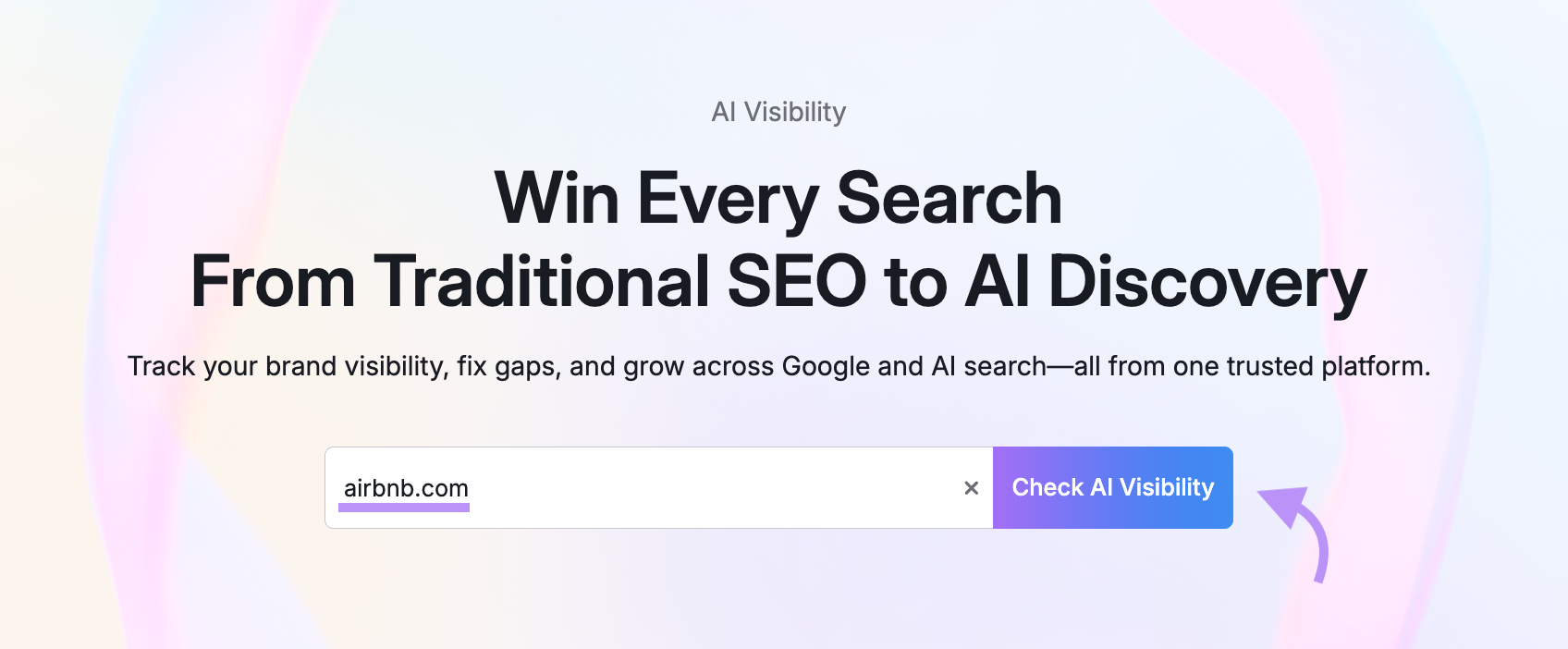
At the top, you’ll see information on how your site performs in different LLMs. Like where your site is mentioned and how frequently.

Click into “TopicOpportunities” to see which prompts users enter into LLMs that you don’t appear for but other brands do.

Review the keywords and prompts to make sure each aligns with your personas and their interests. Then, create pages for each relevant topic.
5. Repurpose Existing Content
Repurposing existing content can help you reach a wider audience without creating new content from scratch, and leaning on AI repurposing tools can help you repurpose content quickly.
For example:
- AI Video Marketing Automator is an app you can use to repurpose blog content into YouTube, TikTok, and Instagram videos
- AI Social Content Generator can repurpose blog content into social media posts
- 2short.ai takes your video content, identifies the most engaging parts, and turns them into short clips
- NotebookLM can turn your existing content into explainer videos
Stella Inabo, Contract Content Marketer for Float, considers how audiences tend to behave on different platforms to determine what formats are best when repurposing. And shares this example:
“If someone is scrolling through LinkedIn and sees a video, they’re likely to expect a sound bite that's interesting, controversial, or thought-provoking.”
6. Promote Content Via Multiple Channels
Sharing your content across various channels can increase each piece’s reach and ultimately drive better business results.
Lean on channels you’ve already built an audience on—like email and your social media following. And consider paid promotional avenues like:
- Influencer marketing: Partner with industry influencers and ask them to share your content to tap into their networks
- Social media ads: Use social media ads using a platform like Meta Ads Manager to tap into a broader audience. You can even use existing organic social posts that have been popular.
- Newsletter ads: Promote your content within another brand’s newsletter. Platforms like Paved can connect you with relevant publications that accept advertisements.
- Display ads: Create promotions that appear on other websites and apps your audience is likely to visit using Google Ads or another ad platform
- Search ads: Create ads on search engines, so you can show prominently in results for specific keywords related to your content
For example, here are some search ads that promote reports for the term “state of b2b marketing:”

7. Experiment with Content Formats
Experimenting with new content lets you discover what resonates most with your audience, so you can refine your strategy to deliver more engaging content and see if different types of content perform better than others in LLMs.
Some content format ideas include:
- Interviews with industry experts
- Case studies
- Short- and long-form videos
- Research reports
- Memes
- Webinars and courses
- User-generated content
- Ebooks
- Whitepapers
- Podcast episodes
- Infographics
For example, this Semrush infographic contains tips to improve your content:

Compare how these different types compare based on metrics such as traffic, organic rankings, AI citations, shares, etc. This will help you see what resonates and which formats deserve your focus moving forward.
8. Focus on User Experience
A good user experience (UX) keeps people engaged with your content for longer and may increase the chances that users will become followers or fans of your brand.
For example, a reader may be more likely to read a blog post that uses a clear, legible font over a blog post with a font that’s difficult to read.
Plus, many techniques that improve UX also optimize your content from a technical perspective. Which can improve visibility in AI tools and search engines.
Here are some tips to improve UX:
- Add closed captions or subtitles to videos so people can watch your videos without sound
- Add alt text—text that describes an image for search engines and screen readers—to images on social media and your website to ensure accessibility
- Ensure your content (including copy within images) is legible on all screen sizes
- Make links different colors than body text so users can easily find clickable elements
- Use descriptive anchor text (the clickable part of a link) so users know a linked page’s topic
- Use clear headers on your website to organize your information and make scanning easy
- Keep paragraphs short—a few sentences at most—so readers don’t feel overwhelmed with walls of text
- Incorporate visuals such as images and videos to break up website text
- Write simply and clearly so readers can easily understand your content
Tools like the Hemingway Editor evaluate your content’s readability. Usually, you’ll want to aim for a score of 60 or higher. Reading scores in that range are suitable for most adults.

9. Continually Update and Optimize Existing Content
Updating blog content (and other content) can increase your credibility and potentially help you get more traffic from search engines and LLMs like ChatGPT.
Heike Young, Head of Content, Social, and Integrated Marketing at Microsoft, says one of the first things she did at a previous company was conduct a content audit to find outdated pages:
“I quickly spotted some very old pieces of content that were still driving lots of traffic. They had outdated messaging, product names, and next steps. We prioritized fixing those to create a much better audience journey.”
Heike notes that content marketers should repeat audits and refreshes at least once a year, if not more often.
To start your audit, use an analytics tool like Google Analytics to find pages with the most traffic.

Then, review the content on these pages to find any outdated information to update. Such as removing mentions of products you no longer offer.
Next, use Google Search Console (GSC) to find pages that have declining rankings in search results.
Click “Performance.” Check the box next to “Average position” and uncheck those beside “Total clicks” and “Total impressions.”

Click “More” to adjust the time range.

Then, click “Compare,” select which period you want to compare keyword positions for, and click “Apply.”

Scroll down and click on the “Pages” tab to view which pages have seen the most significant declines in rankings.

Study these pages and assess whether you should update them.
If the answer is yes, paste the article into Semrush’s Content Optimizer tool, enter your target keywords, and click “Get improvement ideas.”

The tool will analyze your article and give you tips related to SEO, readability, and tone.

Apply the suggested changes and any other edits you’ve identified as important. Then, publish the updated content to your site.
10. Create Topic Clusters
Topic clusters are groups of related pages designed to help you build topical authority that can lead to ranking higher in the search results.
Topic clusters contain one pillar (main) page and multiple cluster pages (subpages) on more specific subtopics. These pages are connected through internal linking (i.e., these pages all link to one another).
Here’s an example of a topic cluster:

Semrush’s Keyword Strategy Builder automatically creates topic clusters.
Head to the tool, enter one to five seed keywords (broad keywords relevant to your niche), and click “Create.”

When the tool is ready, scroll to the “Page Details” section to view the different pillar and subpage ideas. Click “Easy Start” for a list of keywords you’ll have the best chance at ranking for.
Then, click the “Create brief or content” button on any page to send the idea directly to the Content Toolkit. So you can begin writing and optimizing your new pages.

Publish your optimized pages. And remember to include internal links to the other pages in the cluster as you publish.
Find the Best Tactics for Your Brand
Test different content marketing tips yourself to see which ones have the greatest impact on your results.
That doesn’t mean you need to try every tip—start with one or two. And make sure you have the right tools.
If you’re eager to improve your LLM performance, try Semrush’s AI Visibility Toolkit.